

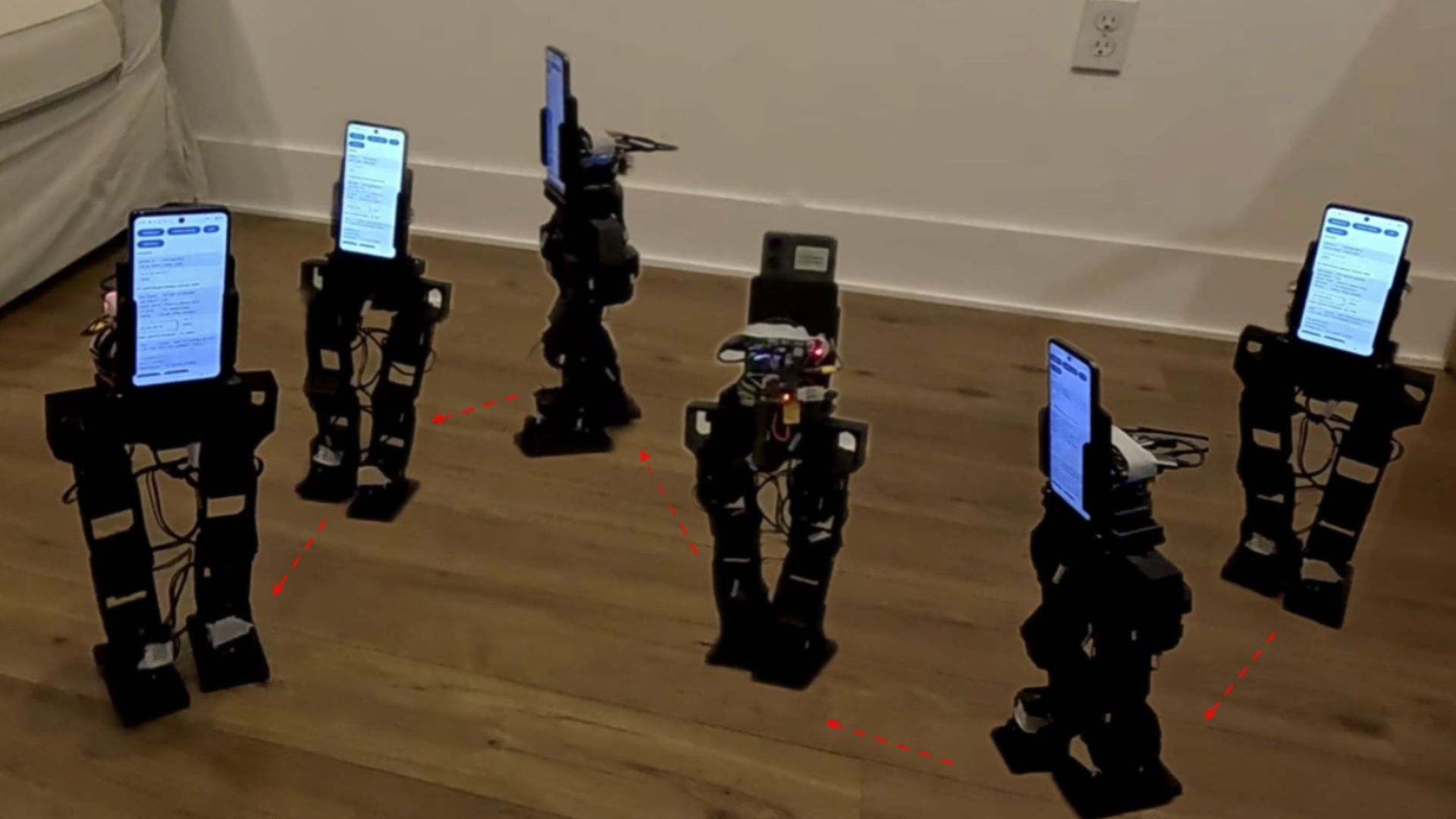
Researchers at the University of California, Los Angeles (UCLA), developed PhoneBot, an open-source humanoid robot that uses an Android smartphone for sensing and computing. Its robotic hardware costs about $400, excluding the phone.
PhoneBot stands 483 mm tall and weighs 1.8 kg. Thirteen servo motors control its legs and rotating torso. The phone’s camera tracks people, while its built-in inertial measurement unit provides motion data for balance and walking control. A separate computer in the robot receives wireless commands over Wi-Fi and translates them into joint movements.
The researchers tested four Android phones: a 2017 Honor 9 and three inexpensive handsets priced at about $50 to $80. All four supported core functions, including motion sensing, walking control, visual detection and human interaction, though features varied by model. The phone runs locomotion policies through TensorFlow Lite and supports person detection and pose estimation.
After early simulations produced uneven steps, the team trained the walking controller with mirrored left- and right-side examples. Across five independent training runs, this reduced joint-angle symmetry error from 0.254 radians to 0.003 radians. Left-right torque imbalance fell from 0.205 to 0.034, and mechanical-power imbalance from 0.339 to 0.040.
Demonstrations included walking, recovering from a face-down position and turning the phone’s camera toward people without constantly turning the robot’s feet. The platform’s low-powered servos limit its payload and reliable dynamic movement. Its controller was trained on flat ground, and it has no arms for handling objects. The research is available on arXiv, where papers may be shared before or alongside peer review.
Comments
0No comments yet. Be the first to comment.