

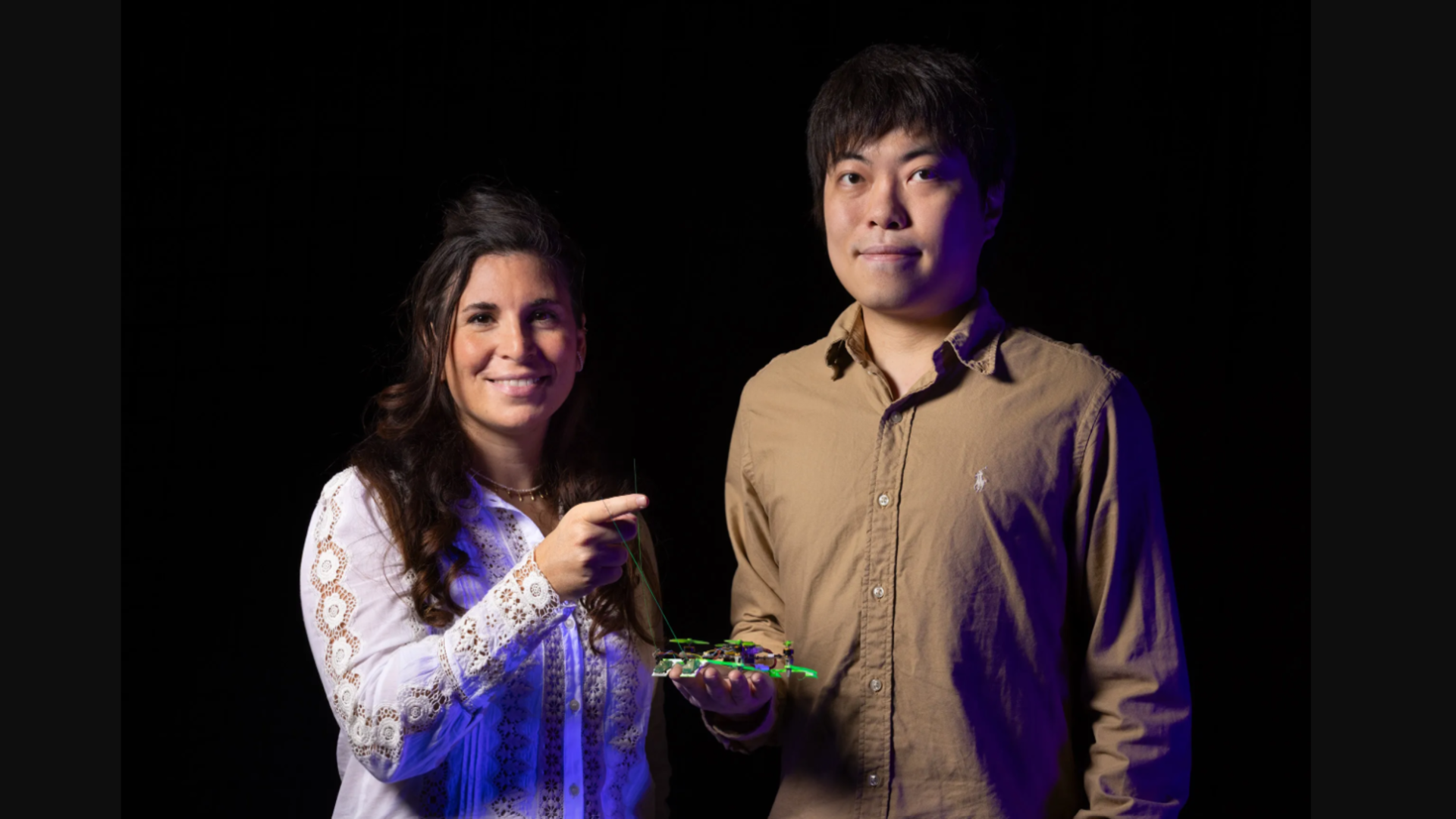
Researchers at Delft University of Technology in the Netherlands have developed a tiny drone that uses artificial whiskers to navigate where cameras and satellite positioning may struggle. Designed for aircraft weighing below 100 grams, the system relies on physical contact with nearby surfaces instead of visual information or GPS.
The drone carries two slender filaments near its nose. Each filament connects to miniature pressure sensors, and contact with an object changes the pressure readings. The drone can use that information to estimate its position, move around obstacles, maintain contact with structures, and build a basic representation of its surroundings.
Airflow was a major challenge because wind can disturb the whiskers and confuse the sensors. The researchers addressed this with a lightweight program that separates turbulence from genuine surface contact in real time with millimetric precision. The complete onboard software occupies only 34 kilobytes of memory.
“Here, we aim to equip drones with rich tactile sensing — not for manipulation in the air, but for a novel concept of tactile navigation,” said Salua Hamaza, Associate Professor of Aerial Physical Interaction and Embodied Intelligence. Chaoxiang Ye, a PhD candidate and researcher at Delft, said the work was intended to show that touch does not have to come at the cost of size or computational power.
The approach may be useful in smoke, dust, darkness, or damaged infrastructure, including collapsed buildings where small drones could enter tight spaces ahead of human responders. The researchers note that it will not suit the fastest drones.
Comments
0No comments yet. Be the first to comment.