

AMD has showcased a ray tracing technique that could reduce the memory and computational costs of rendering complex animated environments, according to Wccftech.
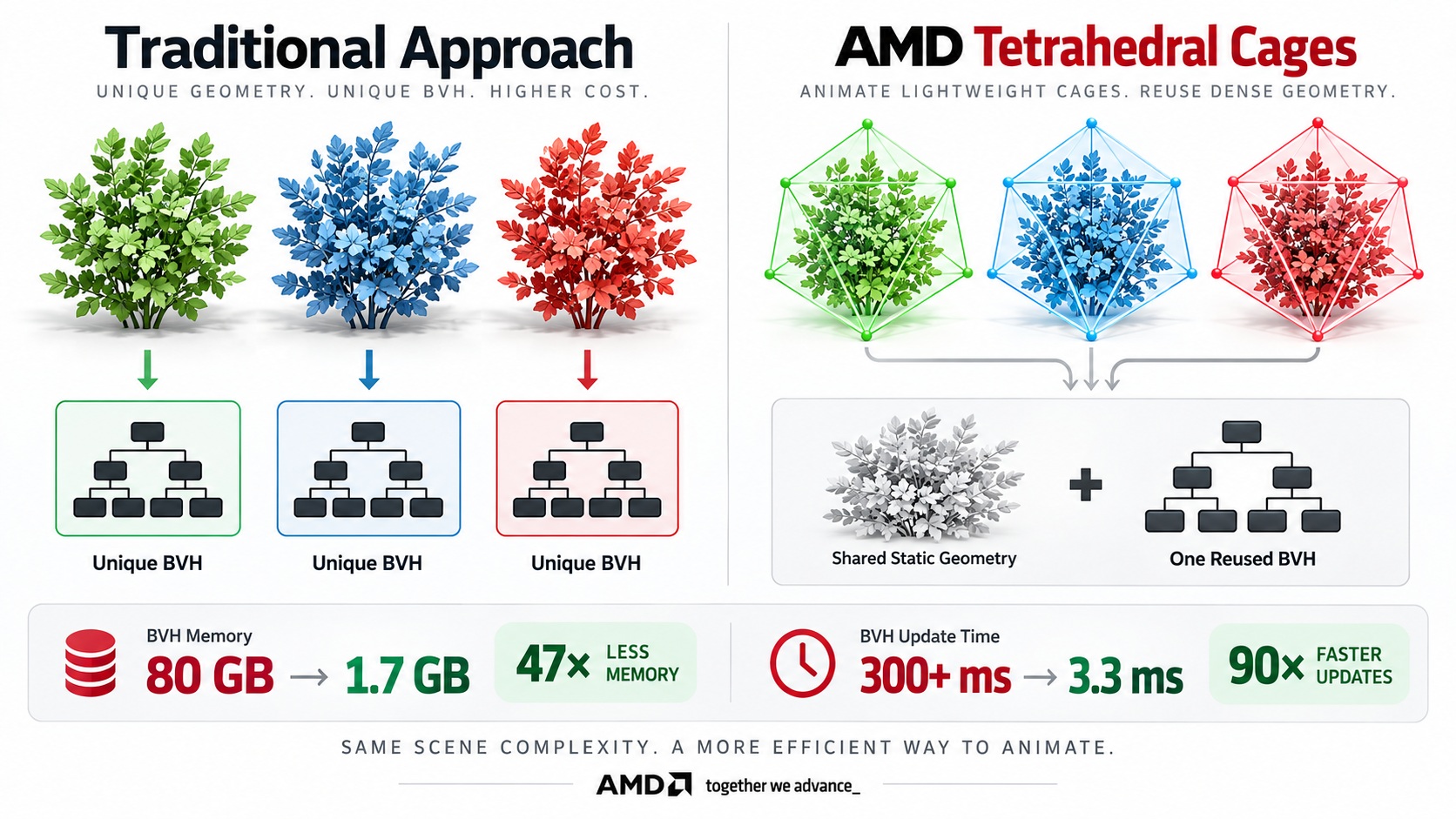
The tetrahedral cage technique is designed to ray trace hundreds of millions of independently animated triangles in real time. It reduces the acceleration-structure overhead associated with a Bounding Volume Hierarchy, or BVH.
In a GPUOpen article published on September 17, AMD Fellow Holger Gruen demonstrated the technique with a large terrain scene containing approximately 25,000 independently animated plants. At their maximum level of detail, the plants represent roughly 500 million animated triangles.
The demonstration used an RX 9070 XT and reportedly ran at 60+ FPS. The BVH memory requirement fell from 80 GB to just 1.7 GB in the example described by the report.
AMD's results suggest that tetrahedral cages could make real-time ray tracing more practical for large animated scenes, although the available source describes a research demonstration rather than a product announcement.
Comments
0No comments yet. Be the first to comment.