

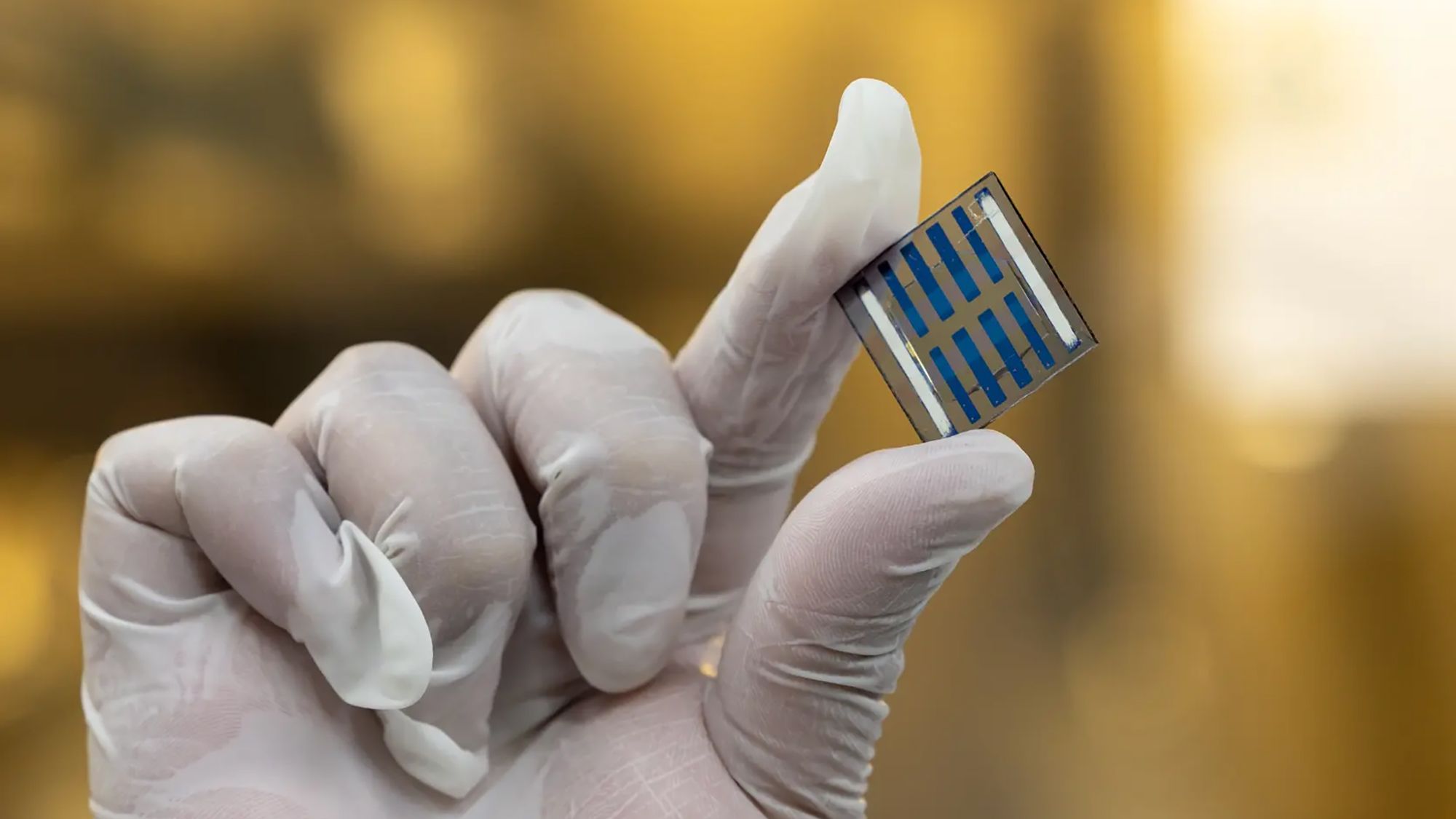
Researchers at the Institut de Ciències Fotòniques (ICFO) in Barcelona tested a solar cell with a very thin silver front electrode. The layer lets most sunlight through, conducts electricity and acts partly like a mirror, restricting the angles at which light can escape.
In standard single-layer solar cells, the Shockley-Queisser limit puts the theoretical conversion ceiling at 33%. One contributor to energy loss is the faint infrared glow emitted when electrons escape the cell and return to a lower-energy state, producing photons. The researchers’ approach targets this light loss, known as Boltzmann loss.
The team observed small efficiency gains in its tests. It says that adapting and developing the method could, in theory, bring efficiency close to 43%. That figure is a prediction, not a measured result. The article reports that earlier attempts to make this “mirrored box” approach work in a lab had not achieved simultaneous gains in voltage and current.
Other approaches target heat loss. Earlier this year, Chinese solar manufacturer Longi reported 35.5% efficiency for a cell combining perovskite and silicon. Separately, researchers at Kyushu University and Johannes Gutenberg University Mainz reported a quantum yield of 130% using singlet fission. Quantum yield is not an efficiency rate; the method produced 13 energy packets for every 10 photons. Further work is needed to develop it.
Comments
0No comments yet. Be the first to comment.